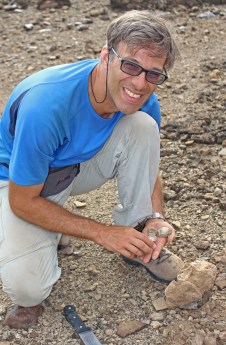
 Bert is an integrative evolutionary biologist and a tenured research scientist of the French Centre National de la Recherche Scientifique (CNRS). His research spans the intricate patterns and processes of organismal diversification, changes in morphological disparity, and the dynamic interaction between organisms and their environments. Having received a Ph.D. in paleobiology from Ghent University (2011), he has dedicated his career to studying African freshwater mollusks, particularly the evolutionary radiations in the East African Rift System. He has explored the evolution, systematics, paleoecology and shifting geographic distributions of the Late Cenozoic freshwater mollusks of the Turkana Basin since 2005. His team integrates data from both living and fossil species focusing on empirical data, models and experiments to piece together ecology and evolutionary history.
Bert joined the WTAP in 2021, driven by a deep interest in reconstructing the aquatic paleoenvironments that once supported freshwater mollusk communities and how they changed through time. These paleoenvironments, and their stability—or instability—across time and space, were crucial to human adaptation and evolution. In this context, he is particularly fascinated by how early humans exploited aquatic resources.
In his own words
What do you like about being in the field in Turkana?
“The thrill of uncovering fossil freshwater mollusks.”What do you miss when you are in the field?
“Living freshwater mollusks. (And maybe a cold drink.)”How would you describe your role in the WTAP team?
“Like everything else, constantly evolving.”
For more information about Bert’s research or to contact him directly, please visit his page on Researchgate
 West Turkana Archaeological Project